
SUMMARY
- OEM certifications demonstrate that a collision repair facility has met manufacturer requirements for repairing specific vehicle brands.
- Certified shops invest in specialized equipment, technician training, and manufacturer-approved repair procedures.
- OEM certifications help ensure repairs follow current manufacturer recommendations whenever applicable.
- Modern vehicles often require advanced diagnostics, structural measurements, and electronic system verification after a collision.
- Choosing an OEM-certified repair facility can provide greater confidence in repair quality and long-term vehicle performance.
- Drivers in Providence, RI should understand what OEM certifications represent before selecting a collision repair center.
- A professional inspection helps determine the correct repair procedures for every vehicle.
- Choice Collision Centers is committed to quality repairs using manufacturer-informed procedures and advanced repair technology.
After an accident, many drivers focus on repairing visible damage such as dents, broken bumpers, or scratched paint. However, modern collision repair involves much more than restoring appearance. Today’s vehicles are built with advanced materials, complex structural designs, and sophisticated safety systems that require precise repair procedures.
One term many customers encounter during their search for a repair facility is OEM certification. While it appears frequently on collision repair websites, many drivers are unsure what it actually means or why it matters.
Understanding OEM certifications helps vehicle owners make informed decisions about who repairs their vehicle after an accident and why proper repair procedures play an important role in both safety and long-term vehicle performance.
What Does OEM Mean?
OEM stands for Original Equipment Manufacturer.
An OEM is the company that designed and built your vehicle.
Examples include:
- Honda
- Toyota
- Ford
- Chevrolet
- Tesla
- Subaru
- Mercedes-Benz
Each manufacturer develops specific repair procedures based on extensive engineering, crash testing, and vehicle design.
According to the National Highway Traffic Safety Administration, proper repairs help preserve the safety performance engineered into today’s vehicles.
When a vehicle leaves the factory, every component has been designed to work together as part of a carefully engineered system. From the frame and body panels to the airbags and advanced driver assistance systems, manufacturers test these components extensively to ensure they perform as intended during everyday driving and in the event of a collision.
Because every make and model is built differently, repair procedures that are appropriate for one vehicle may not be suitable for another. This is why OEMs publish detailed repair information that guides technicians through the correct methods for inspecting, repairing, or replacing damaged components.
OEM repair procedures continue to evolve as vehicle technology advances. Modern vehicles often incorporate high-strength steel, aluminum, composite materials, and sophisticated electronic systems that require specialized tools and repair techniques.
Manufacturers regularly update their repair information to reflect new engineering developments, helping repair facilities stay current with the latest recommendations. Following these procedures helps technicians restore the vehicle using methods developed specifically for its design rather than relying on generalized repair practices.
For drivers in Providence, RI, understanding what an OEM is provides valuable context when selecting a collision repair facility. Choice Collision Centers recognizes the importance of manufacturer-informed repair procedures and ongoing technician education to address today’s increasingly complex vehicles.
By combining advanced repair technology with proven repair practices, the team works to restore each vehicle’s appearance, structural integrity, and safety systems while providing customers with honest communication and professional service throughout the repair process.
What Is an OEM Certification?
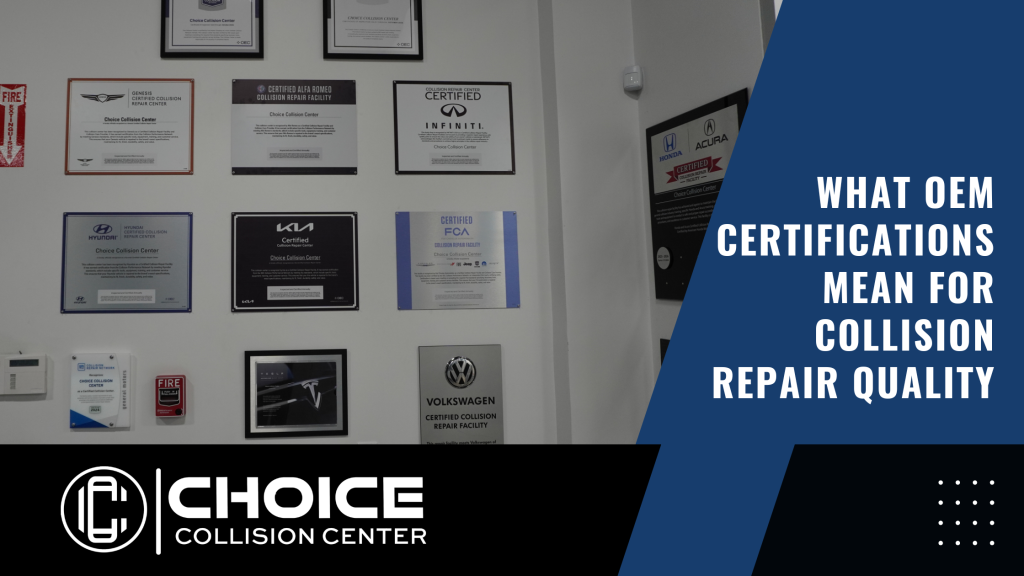
An OEM certification indicates that a collision repair facility has met specific requirements established by an individual vehicle manufacturer.
Certification programs often evaluate areas such as:
- Technician training
- Repair equipment
- Facility standards
- Repair procedures
- Quality control
- Ongoing education
Every manufacturer establishes its own certification requirements, meaning certifications differ from one brand to another.
Learning about OEM Certified Repairs helps drivers better understand how manufacturer standards influence today’s collision repair industry.
Why Manufacturers Offer Certification Programs
Modern vehicles are engineered differently than they were even a decade ago.
Today’s vehicles often include:
- High-strength steel
- Aluminum components
- Carbon fiber materials
- Advanced Driver Assistance Systems (ADAS)
- Complex structural designs
- Electronic safety systems
Manufacturers create certification programs to help ensure repair facilities have the training and equipment necessary to repair these increasingly sophisticated vehicles correctly.
According to I-CAR, continuing technician education is essential because vehicle technology continues evolving every year.
Vehicle manufacturers invest years in research, engineering, and crash testing before a new model reaches the road. Every material, weld, structural component, and safety feature is carefully designed to perform in a specific way during a collision. As vehicles become lighter, stronger, and more technologically advanced, repairing them has become increasingly complex.
Certification programs help manufacturers ensure that participating collision repair facilities understand these engineering principles and have access to the latest repair information, specialized equipment, and approved repair techniques needed to restore vehicles properly.
Certification programs also encourage repair facilities to make ongoing investments in their operations rather than relying on outdated methods. Technicians receive continuing education on new vehicle designs, repair procedures, and emerging technologies, while shops maintain specialized tools, measuring systems, welding equipment, and diagnostic devices required for modern repairs.
These programs are regularly updated as manufacturers introduce new models and revise repair recommendations, helping certified facilities stay aligned with current industry standards.
For drivers in Providence, RI, choosing a repair facility that values ongoing training and manufacturer-informed repair practices can provide greater confidence after a collision. Choice Collision Centers understands that modern vehicles require more than traditional body repair techniques.
By investing in advanced equipment, continuous technician education, and repair processes that reflect current manufacturer guidance whenever applicable, the team is committed to delivering high-quality repairs that help restore your vehicle’s appearance, structural integrity, and safety systems while providing exceptional customer service throughout the entire repair process.
OEM Certifications Go Beyond Technician Training
Many drivers assume OEM certification simply means technicians attend training classes.
In reality, certification programs often require investments in:
- Specialized repair equipment
- Manufacturer-approved measuring systems
- Welding equipment
- Diagnostic tools
- Repair documentation
- Facility improvements
These investments help repair facilities perform repairs according to manufacturer specifications whenever applicable.
Why Repair Procedures Matter
No two vehicles are engineered exactly alike.
Manufacturers develop repair procedures that may specify:
- Approved replacement parts
- Structural repair methods
- Welding procedures
- Riveting techniques
- Adhesive bonding methods
- Electronic system verification
Following manufacturer repair information helps technicians understand how each vehicle was designed to perform before the collision occurred.
Drivers requiring professional collision repair often benefit from repair procedures developed specifically for their vehicle’s make and model.
Modern Vehicles Require Advanced Diagnostics
Collision repair today extends far beyond replacing damaged body panels.
Modern repairs often include:
- Pre-repair diagnostic scans
- Post-repair verification
- Sensor inspections
- Structural measurements
- ADAS verification
- Final quality inspections
Many advanced safety features depend upon precise positioning and calibration following repairs.
Drivers seeking professional Scans & Calibrations often discover these procedures are an important part of restoring modern vehicles after a collision.
According to the Insurance Institute for Highway Safety, modern vehicle safety systems play an important role in crash avoidance and occupant protection.
OEM Certification Supports Repair Consistency
Certification programs also encourage repair consistency.
Repair facilities often follow documented procedures covering:
- Vehicle inspections
- Damage documentation
- Structural measurements
- Repair planning
- Quality verification
- Final inspections
These standardized processes help reduce variability throughout the repair process.
Why Quality Matters More Than Speed
After an accident, many customers understandably want repairs completed as quickly as possible.
However, quality collision repair requires time for:
- Comprehensive inspections
- Hidden damage identification
- Proper repair planning
- Parts verification
- Diagnostic procedures
- Final quality control
Professional repair facilities focus on restoring both appearance and vehicle performance rather than simply completing repairs quickly.
According to Consumer Reports, consumers should evaluate technician qualifications, repair quality, and communication instead of selecting a repair facility based only on price or repair speed.
Transparency Builds Customer Confidence
One advantage of choosing an experienced collision repair facility is clear communication.
Customers should understand:
- Why repairs are recommended
- Which procedures will be performed
- Whether hidden damage exists
- Estimated repair timelines
- Quality control procedures
Transparency helps customers make informed decisions throughout the repair process.
Questions to Ask Before Choosing a Repair Facility
Before authorizing repairs, consider asking:
- Which OEM certifications do you hold?
- How do you identify hidden damage?
- Do you follow manufacturer repair procedures?
- Will diagnostic scans be performed?
- How is repair quality verified?
- How will repair updates be communicated?
These questions provide valuable insight into how a repair facility approaches collision repair.
Frequently Asked Questions
1. What does OEM stand for?
OEM stands for Original Equipment Manufacturer, the company that designed and built your vehicle.
2. Does OEM certification guarantee perfect repairs?
No certification can guarantee every outcome, but OEM certification demonstrates that a repair facility has met manufacturer requirements for specific vehicle brands.
3. Why are OEM repair procedures important?
They provide manufacturer-developed guidance for repairing specific vehicle models using approved methods.
4. Do all body shops have OEM certifications?
No. Certification requirements vary by manufacturer, and not every repair facility participates in every OEM program.
5. Why do modern vehicles require more specialized repairs?
Modern vehicles include advanced materials, electronics, sensors, and safety systems that require specialized repair procedures.
6. Are diagnostic scans necessary after a collision?
Many manufacturers recommend diagnostic scans before and after repairs to verify the operation of electronic systems.
7. Can OEM-certified shops work with insurance companies?
Yes. Many OEM-certified collision centers regularly coordinate with insurance companies throughout the repair process.
8. Why choose Choice Collision Centers?
Choice Collision Centers combines advanced repair technology, manufacturer-informed repair procedures, ongoing technician education, and customer-first communication to help restore vehicles safely and professionally.
Conclusion
OEM certifications represent far more than a logo displayed on a repair facility’s website. They reflect a commitment to ongoing technician education, specialized repair equipment, manufacturer-informed repair procedures, and continuous investment in the ability to repair today’s increasingly advanced vehicles. While every collision is different, understanding what OEM certifications mean helps drivers make informed decisions when selecting a repair facility after an accident.
If your vehicle has been involved in a collision in Providence, RI, Choice Collision Centers is here to help. Visit 125 Ernest St, Providence, RI 02905, United States, to schedule a professional inspection, learn more about our repair process, or request an estimate from a team committed to quality workmanship, transparent communication, and customer-focused service.
